
Decomposing Series
The trend extraction methods covered in the other vignettes return a
single smooth component. Often, though, an economic series is more
naturally described as the sum of three parts: a slow-moving
trend, a repeating seasonal pattern,
and an irregular remainder.
decompose_series() splits a series into these three
components and adds them as columns to the original data frame.
The theme below is used throughout the vignette for consistent styling.
library(ggplot2)
library(ekioplot)

series_palette <- unname(c(
  ekio_pal("blue")["700"],
  ekio_pal("blue")["400"],
  ekio_pal("teal")["600"]
))
highlight_gold <- unname(ekio_pal("gold")["light"])
highlight_orange <- unname(ekio_pal("orange")["400"])
article_palette <- c(series_palette, highlight_gold, highlight_orange)

article_theme <- theme_ekio(background = "white") +
  theme(
    legend.position = "bottom",
    axis.title.x = element_blank(),
    palette.colour.discrete = article_palette,
    palette.fill.discrete = article_palette
  )
Trend extraction vs decomposition
-
augment_trends()returns only the trend (trend_*columns). The seasonal and irregular movements are smoothed away. -
decompose_series()returns the trend, seasonal, and remainder components (trend_*,seasonal_*, andremainder_*), which should add back up to the original series.
Because there is a seasonal component,
decompose_series() requires seasonal data: monthly
(frequency = 12) or quarterly (frequency = 4).
For annual series there is nothing seasonal to isolate, so use
augment_trends() instead.
A first decomposition
Let’s start with the gdp_construction dataset, a
quarterly index of Brazilian construction activity that ships with
trendseries.
ggplot(gdp_construction, aes(date, index)) +
  geom_line(lwd = 0.7) +
  scale_x_date(date_breaks = "2 years", date_labels = "%Y") +
  labs(
    title = "Brazilian construction activity",
    y = "Index"
  ) +
  article_theme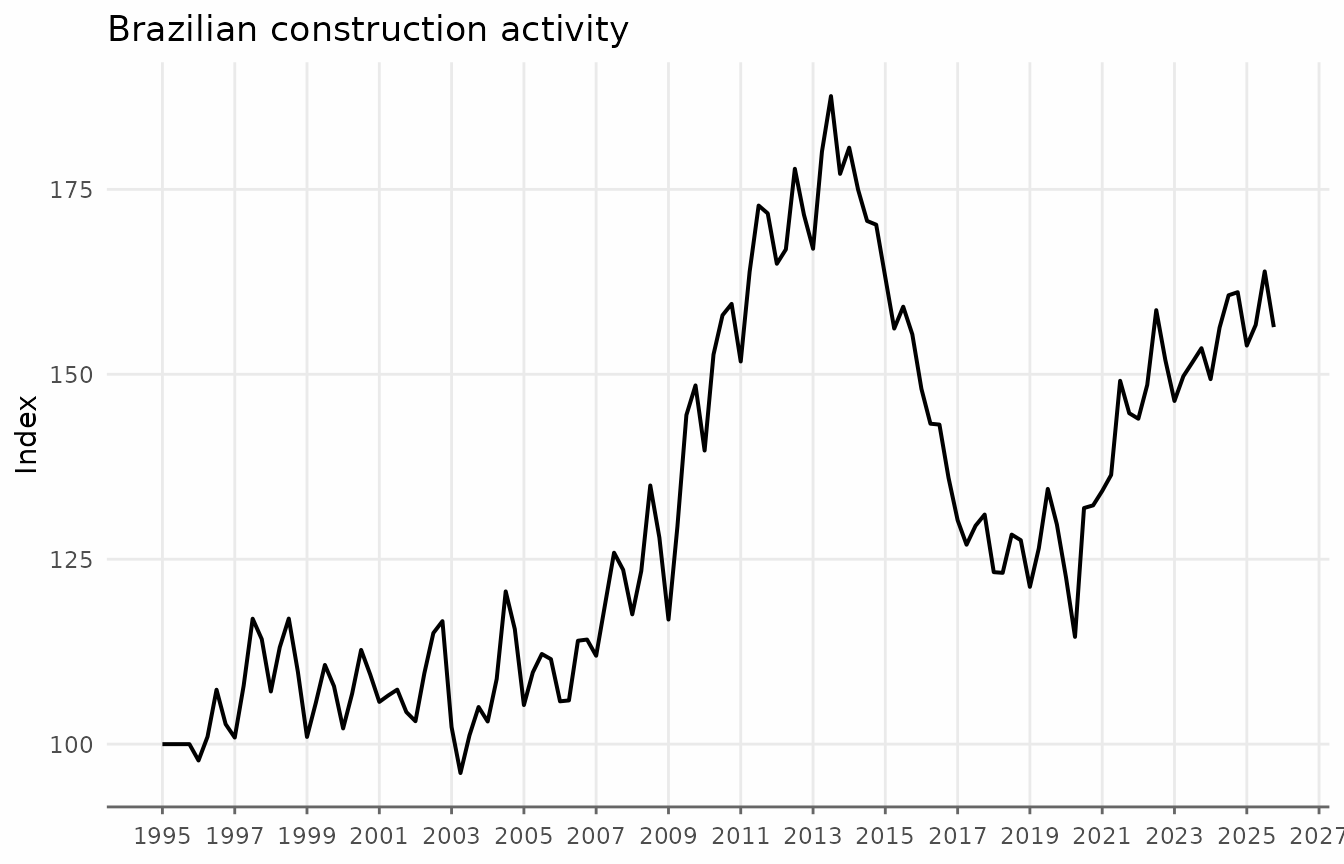
Passing the data to decompose_series() adds three new
columns. The frequency is detected automatically from the date
column.
gdp_parts <- gdp_construction |>
  decompose_series(value_col = "index")

gdp_parts
#> # A tibble: 124 × 5
#>    date       index trend_stl seasonal_stl remainder_stl
#>    <date>     <dbl>     <dbl>        <dbl>         <dbl>
#>  1 1995-01-01 100       102.         -4.37         1.93
#>  2 1995-04-01 100       101.         -1.62         0.476
#>  3 1995-07-01 100       100.          4.44        -4.62
#>  4 1995-10-01 100        99.4         1.55        -0.946
#>  5 1996-01-01  97.8     101.         -4.37         1.42
#>  6 1996-04-01 101.      102.         -1.62         0.613
#>  7 1996-07-01 107.      103.          4.44         0.370
#>  8 1996-10-01 103.      104.          1.55        -2.49
#>  9 1997-01-01 101.      106.         -4.37        -0.530
#> 10 1997-04-01 108.      109.         -1.62         0.849
#> # ℹ 114 more rows
The three components are named after the method (stl by
default): trend_stl, seasonal_stl, and
remainder_stl.
Reshaping to long format makes it easy to plot the original series alongside its three components.
gdp_long <- gdp_parts |>
  pivot_longer(
    cols = c(index, trend_stl, seasonal_stl, remainder_stl),
    names_to = "component",
    values_to = "value"
  ) |>
  mutate(
    component = factor(
      component,
      levels = c("index", "trend_stl", "seasonal_stl", "remainder_stl"),
      labels = c("Observed", "Trend", "Seasonal", "Remainder")
    )
  )
ggplot(gdp_long, aes(date, value)) +
  geom_line(aes(color = component), lwd = 0.7, show.legend = FALSE) +
  facet_wrap(vars(component), ncol = 1, scales = "free_y") +
  scale_x_date(date_breaks = "2 years", date_labels = "%Y") +
  labs(
    title = "STL decomposition of construction activity",
    subtitle = "Observed = Trend + Seasonal + Remainder",
    y = NULL
  ) +
  article_theme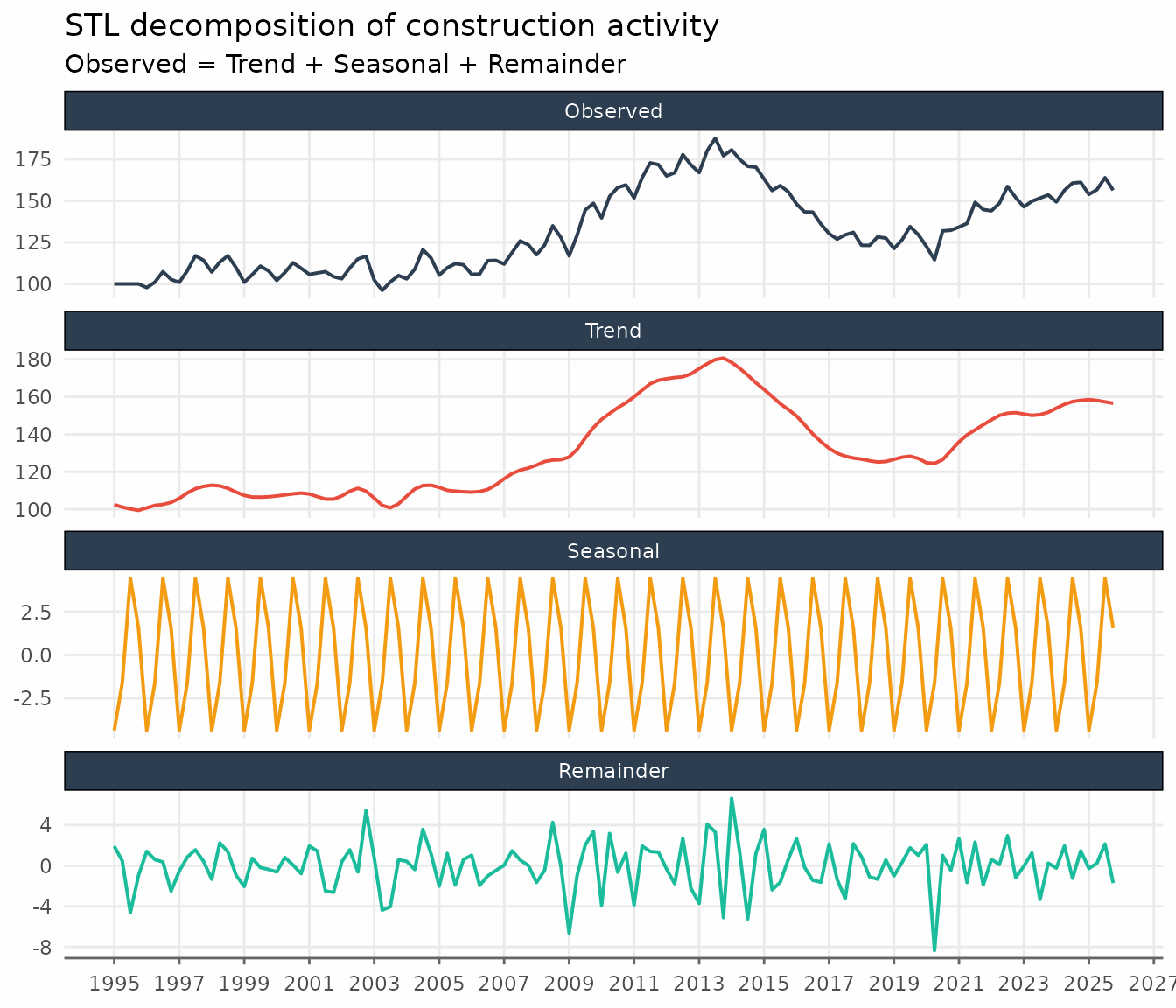
STL decomposition
The default method is STL (Seasonal-Trend
decomposition via Loess), implemented with stats::stl().
The seasonal component is estimated with a loess smoother, the trend
with an adaptive moving average, and the remainder is whatever is left
over. The defaults (s.window = "periodic",
robust = FALSE) assume a stable seasonal pattern.
The params list gives finer control. Two common
adjustments are an evolving seasonal pattern and robust fitting.
# Allow the seasonal pattern to evolve slowly over time, and downweight outliers
gdp_robust <- gdp_construction |>
  decompose_series(
    value_col = "index",
    params = list(s.window = 13, robust = TRUE)
  )
A s.window of "periodic" forces an
identical seasonal shape in every year; supplying a positive odd integer
instead lets that shape drift gradually. Setting
robust = TRUE reduces the influence of one-off spikes on
the trend and seasonal estimates.
Regression decomposition
The regression method
(methods = "regression") fits a single OLS model
where is a polynomial in time and is a set of period (month or quarter) dummy variables. The trend is the constant plus the polynomial terms, the seasonal component is the period effect (centred to mean zero), and the remainder is the model residual.
Unlike STL, the regression trend is a smooth global polynomial, which
can be a better description of a series with a steady long-run
direction. For the examples that follow we use the
oil_derivatives dataset, which records monthly
petroleum-derivatives production in Brazil; we restrict it to the
1995–2006 window and work on the log scale.
suboil <- oil_derivatives |>
  filter(between(date, as.Date("1995-06-01"), as.Date("2006-12-01"))) |>
  mutate(lprod = log(production))

ggplot(suboil, aes(date, lprod)) +
  geom_line(lwd = 0.7) +
  labs(
    title = "Petroleum derivatives production",
    y = "Thousand barrels per day (log scale)"
  ) +
  article_theme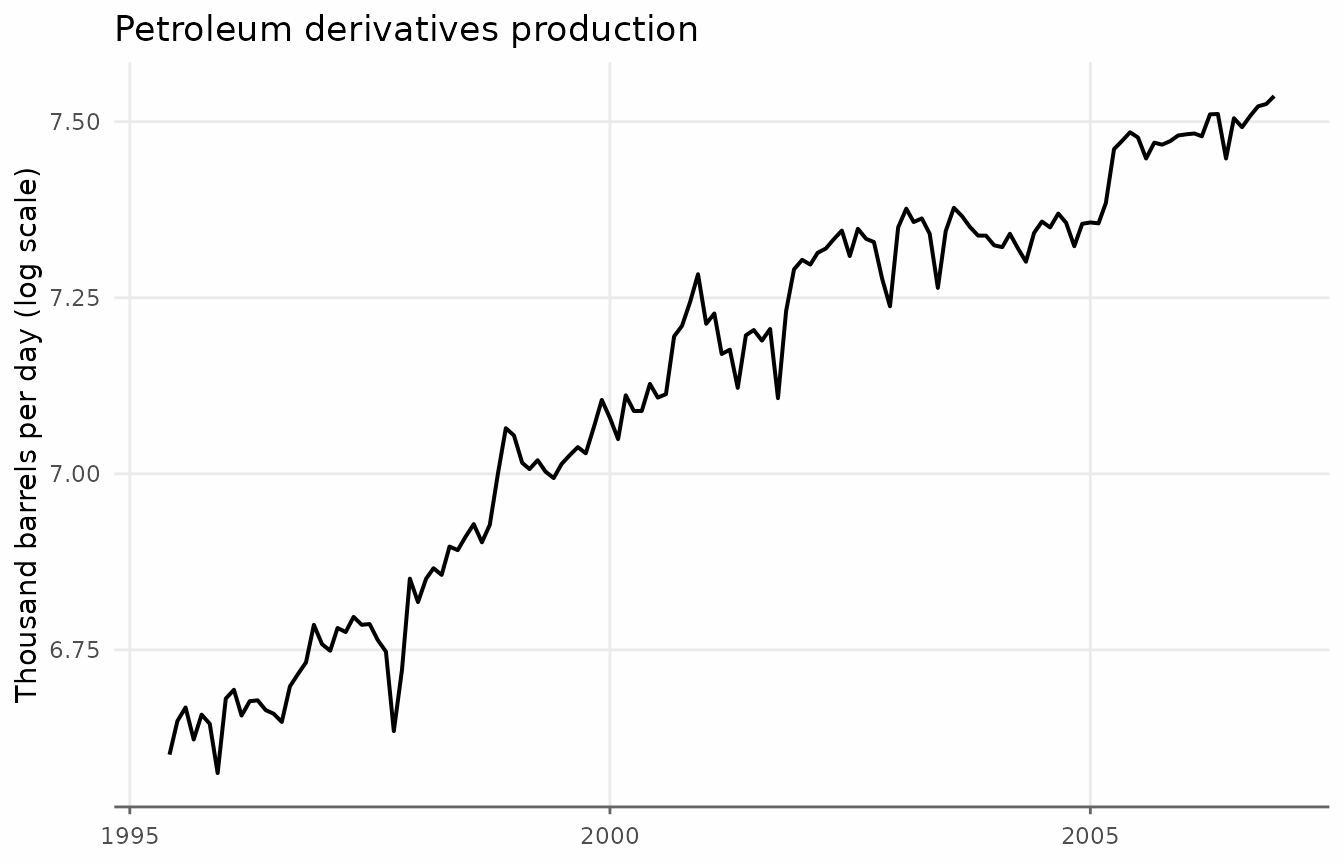
The trend argument selects the polynomial form:
"linear" (the default), "quadratic", or
"cubic". Orthogonal polynomials are used by default for
numerical stability.
suboil_reg <- suboil |>
  decompose_series(
    value_col = "lprod",
    methods = "regression",
    trend = "cubic"
  )

ggplot(suboil_reg, aes(date)) +
  geom_line(aes(y = lprod, color = "Original"), lwd = 0.7) +
  geom_line(aes(y = trend_regression, color = "Trend (reg.)"), lwd = 0.7) +
  labs(title = "Regression cubic trend", y = "log production", color = NULL) +
  article_theme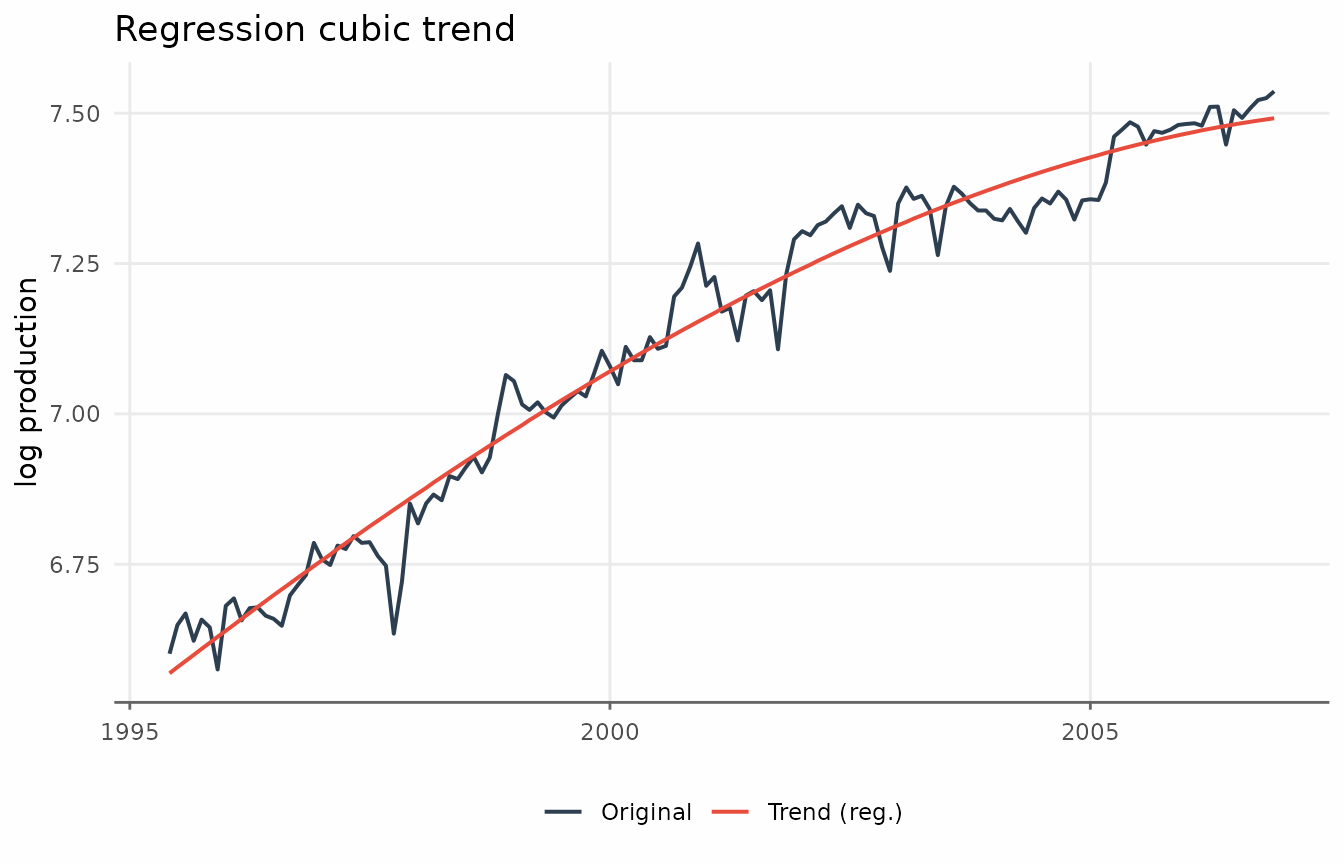
If the series is trend-stationary, remainder_regression
— the series with the trend and seasonality removed — is approximately
stationary.
ggplot(suboil_reg, aes(date, remainder_regression)) +
  geom_line(lwd = 0.7) +
  labs(title = "Regression remainder", y = NULL) +
  article_theme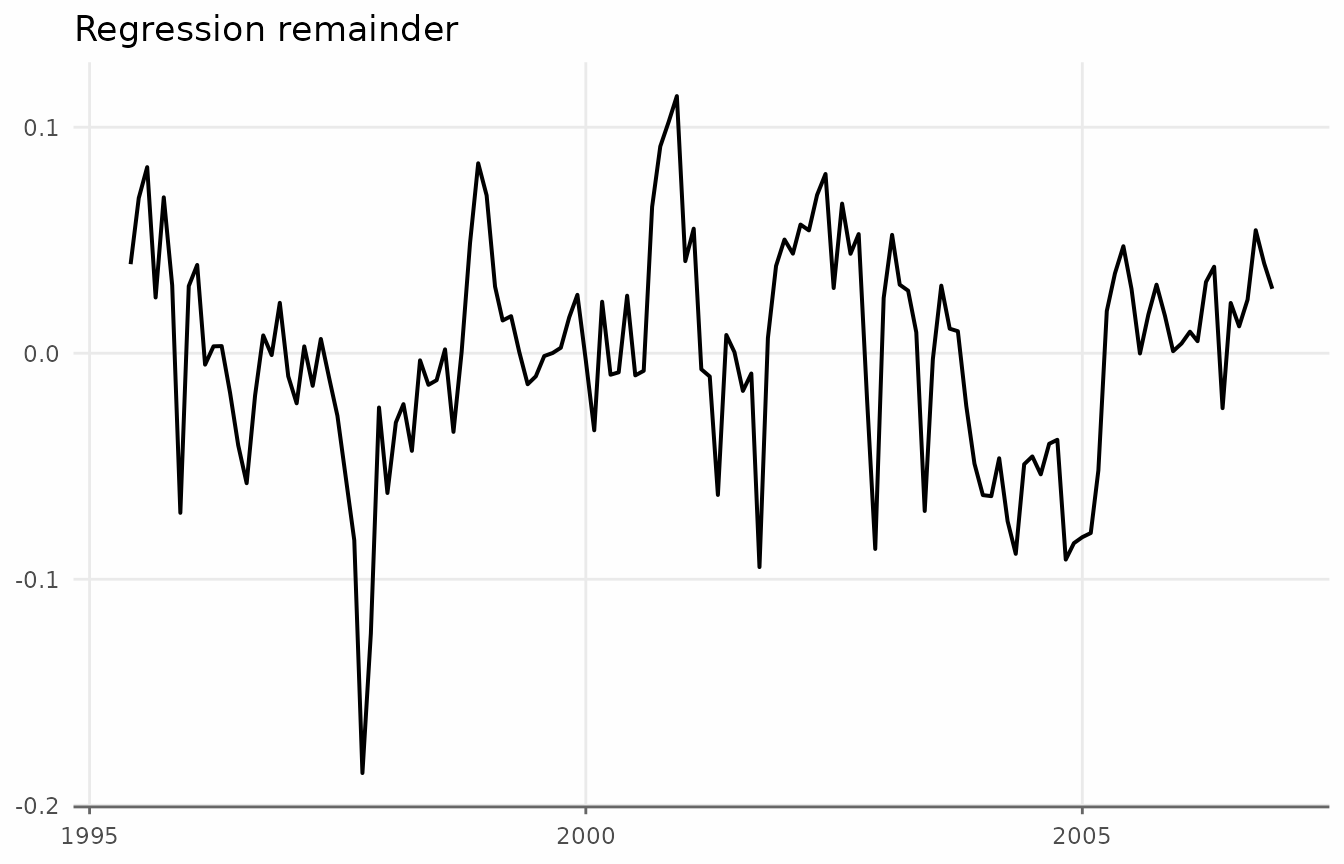
Comparing the two methods directly, both produce fixed seasonal patterns, but STL follows short-term fluctuations more closely, producing a “cleaner” remainder.
comparison <- suboil |>
  decompose_series(value_col = "lprod", methods = "stl") |>
  decompose_series(value_col = "lprod", methods = "regression", trend = "cubic")

comparison_long <- comparison |>
  pivot_longer(
    cols = trend_stl:remainder_regression,
    names_pattern = "(.*)_(.*)",
    names_to = c("component", "method"),
    values_to = "trend"
  ) |>
  mutate(
    component = factor(component, levels = c("trend", "seasonal", "remainder"))
  )

ggplot(comparison_long, aes(date, trend)) +
  # Original series
  geom_line(
    data = suboil,
    aes(y = lprod),
    layout = c(1, 2),
    lwd = 0.5,
    alpha = 0.5
  ) +
  # Components and methods
  geom_line(aes(y = trend, color = component), lwd = 0.7) +
  facet_grid(vars(component), vars(method), scales = "free_y") +
  guides(color = "none") +
  labs(title = "STL vs regression decomposition", y = NULL) +
  article_theme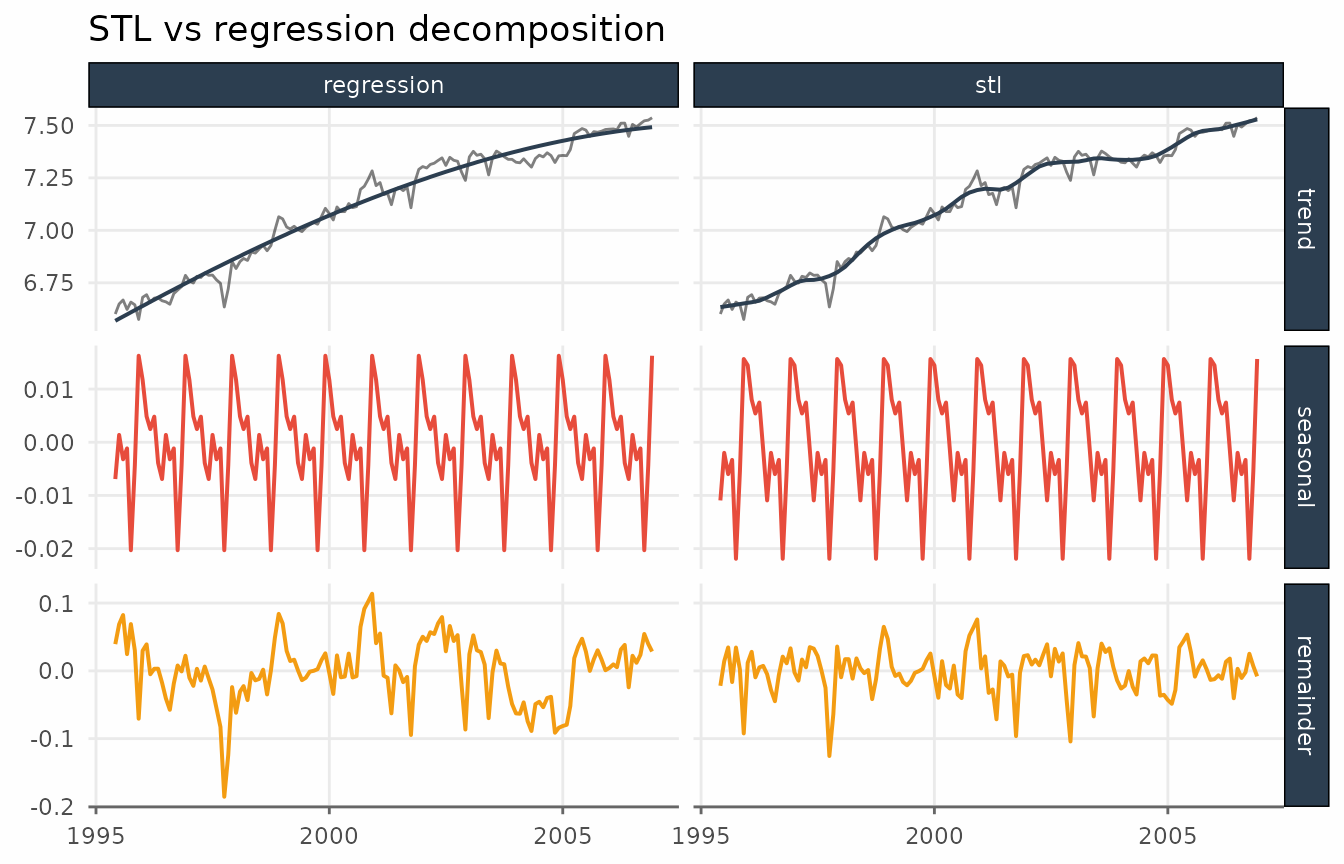
Grouped decomposition
Like augment_trends(), decompose_series()
accepts a group_cols argument to decompose several series
at once. The data must be in tidy format. Here we use the
electricity dataset, which records monthly electricity
consumption for three sectors (residential, commercial, and
industrial).
electricity_parts <- electricity |>
  mutate(lvalue = log(value)) |>
  decompose_series(value_col = "lvalue", group_cols = "name_series")

glimpse(electricity_parts)
#> Rows: 1,689
#> Columns: 7
#> $ date          <date> 1979-02-01, 1979-03-01, 1979-04-01, 1979-05-01, 1979-06…
#> $ name_series   <chr> "electric_residential", "electric_residential", "electri…
#> $ value         <dbl> 1647, 1736, 1681, 1757, 1689, 1730, 1697, 1809, 1789, 18…
#> $ lvalue        <dbl> 7.406711, 7.459339, 7.427144, 7.471363, 7.431892, 7.4558…
#> $ trend_stl     <dbl> 7.418618, 7.428869, 7.439120, 7.448974, 7.458829, 7.4685…
#> $ seasonal_stl  <dbl> 0.018935852, 0.025930126, 0.019210250, -0.006515157, -0.…
#> $ remainder_stl <dbl> -0.0308430776, 0.0045399795, -0.0311857408, 0.0289040622…
Each group is decomposed independently, and the components are stacked back into a single data frame.
ggplot(electricity_parts, aes(date)) +
  geom_line(aes(y = seasonal_stl), color = series_palette[[1]], lwd = 0.8) +
  facet_wrap(vars(name_series), ncol = 1, scales = "free_y") +
  scale_x_date(date_breaks = "3 years", date_labels = "%Y") +
  labs(
    title = "Electricity consumption by sector",
    subtitle = "STL seasonal component extracted per group (log scale)",
    y = "seasonal factor (log)"
  ) +
  article_theme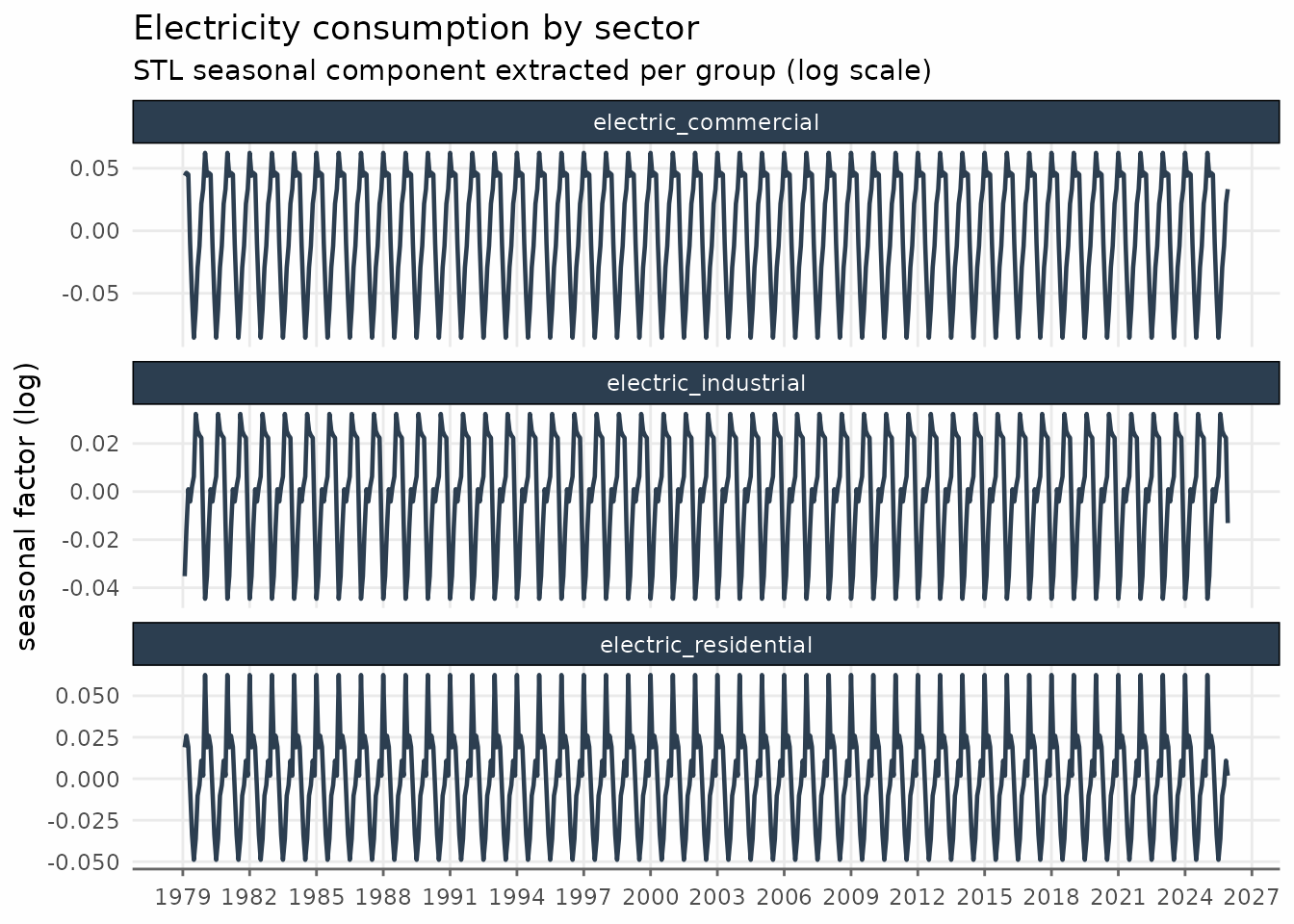
Multiplicative seasonality
So far we have handled multiplicative seasonality by logging the
series before decomposing (lprod = log(production),
lvalue = log(value)). Many macroeconomic series behave this
way: the seasonal variations grow with the level of the series, so an
additive decomposition of the raw data would leave a seasonal pattern
that widens over time.
Every decompose_series() method is additive by
construction. Instead of logging manually, you can pass
transform = "log", which logs the series, decomposes it
additively, and exponentiates the components back to the original
scale.
decompose_series(
  oil_derivatives,
  value_col = "production",
  transform = "log"
)
The decomposition is additive on the log scale, so after
exponentiating the components multiply back to the series:
trend * seasonal * remainder = value. This requires
strictly positive data.
Other methods
Classical decomposition
methods = "classic" is the textbook decomposition
implemented by stats::decompose(). The trend is a centred
moving average of order equal to the frequency, the seasonal component
is the average detrended value for each period, and the remainder is
what is left. It is simple and fast, but the other methods handle
evolving seasonality and the endpoints better.
decompose_series(
  oil_derivatives,
  value_col = "production",
  methods = "classic",
  transform = "log"
)
Basic structural model
methods = "bsm" fits a Basic Structural (state-space)
Model with stats::StructTS(): stochastic level, slope, and
seasonal components estimated by maximum likelihood and extracted with
the Kalman smoother. Unlike the moving-average methods, it returns trend
and seasonal estimates for every observation and lets both
components evolve over time. The trade-off is that it relies on
numerical optimisation, which can occasionally fail to converge on short
or irregular series.
decompose_series(
  suboil,
  value_col = "lprod",
  methods = "bsm"
)
X-13ARIMA-SEATS (seasonal)
methods = "seats" runs the U.S. Census Bureau’s
X-13ARIMA-SEATS program through the seasonal package — the
seasonal-adjustment procedure used by many statistical agencies.
seas() is called with its automatic defaults: ARIMA model
selection, log/level transformation, outlier detection, and calendar
adjustment.
The SEATS trend-cycle and seasonally adjusted series are then mapped
to an additive trend/seasonal/remainder triple. Because X-13 selects its
own transformation internally, there is normally no need to set
transform = "log" for this method. This method requires the
seasonal package to be installed.
# requires the 'seasonal' package
seas_oil <- decompose_series(
  suboil,
  value_col = "lprod",
  methods = "seats"
)

ggplot(seas_oil, aes(date)) +
  geom_line(aes(y = lprod, color = "Original"), lwd = 0.7) +
  geom_line(aes(y = trend_seats, color = "Trend (SEATS)"), lwd = 0.7) +
  labs(title = "SEATS trend-cycle", y = "log production", color = NULL) +
  article_theme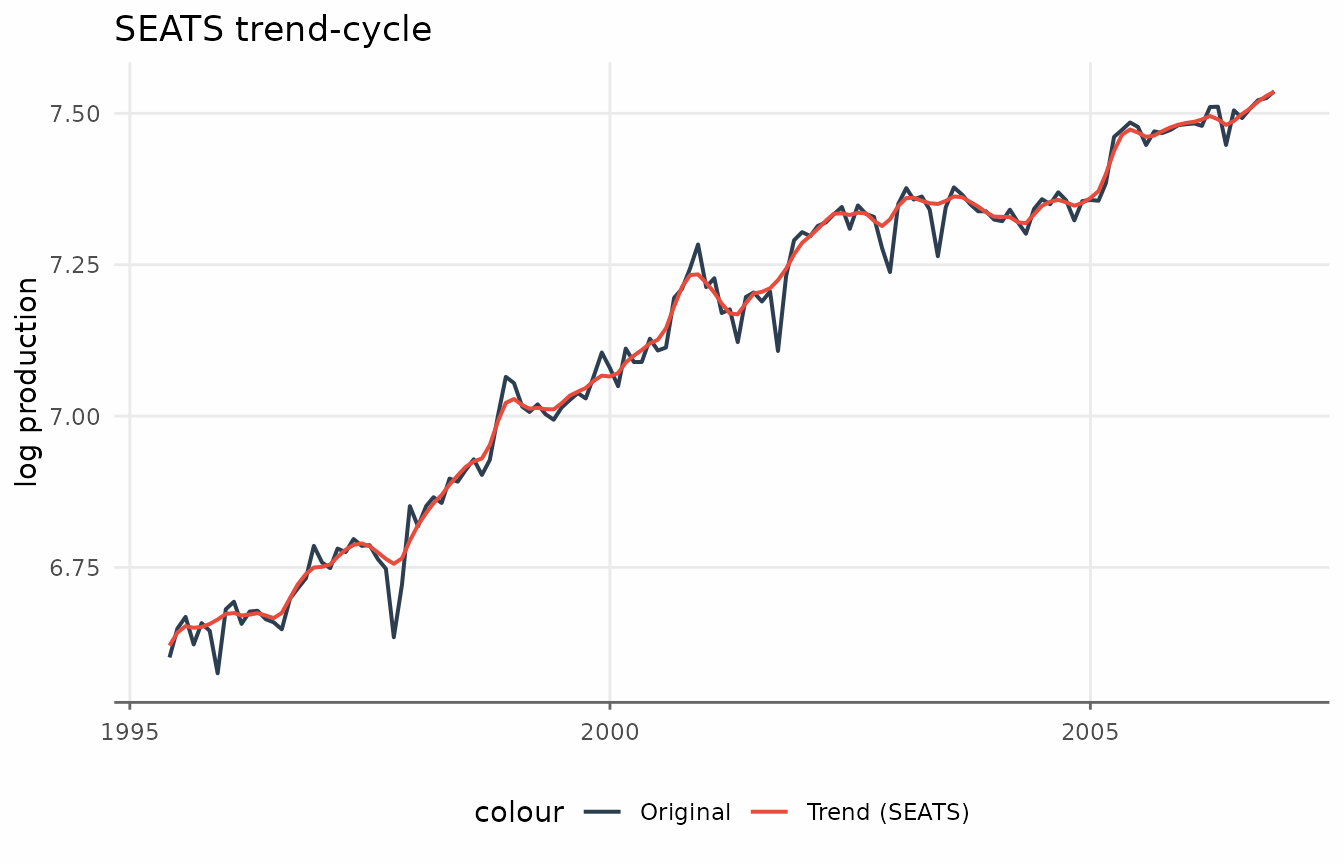
ggplot(seas_oil, aes(date, seasonal_seats)) +
  geom_line(lwd = 0.7) +
  labs(title = "SEATS seasonal component", y = NULL) +
  article_theme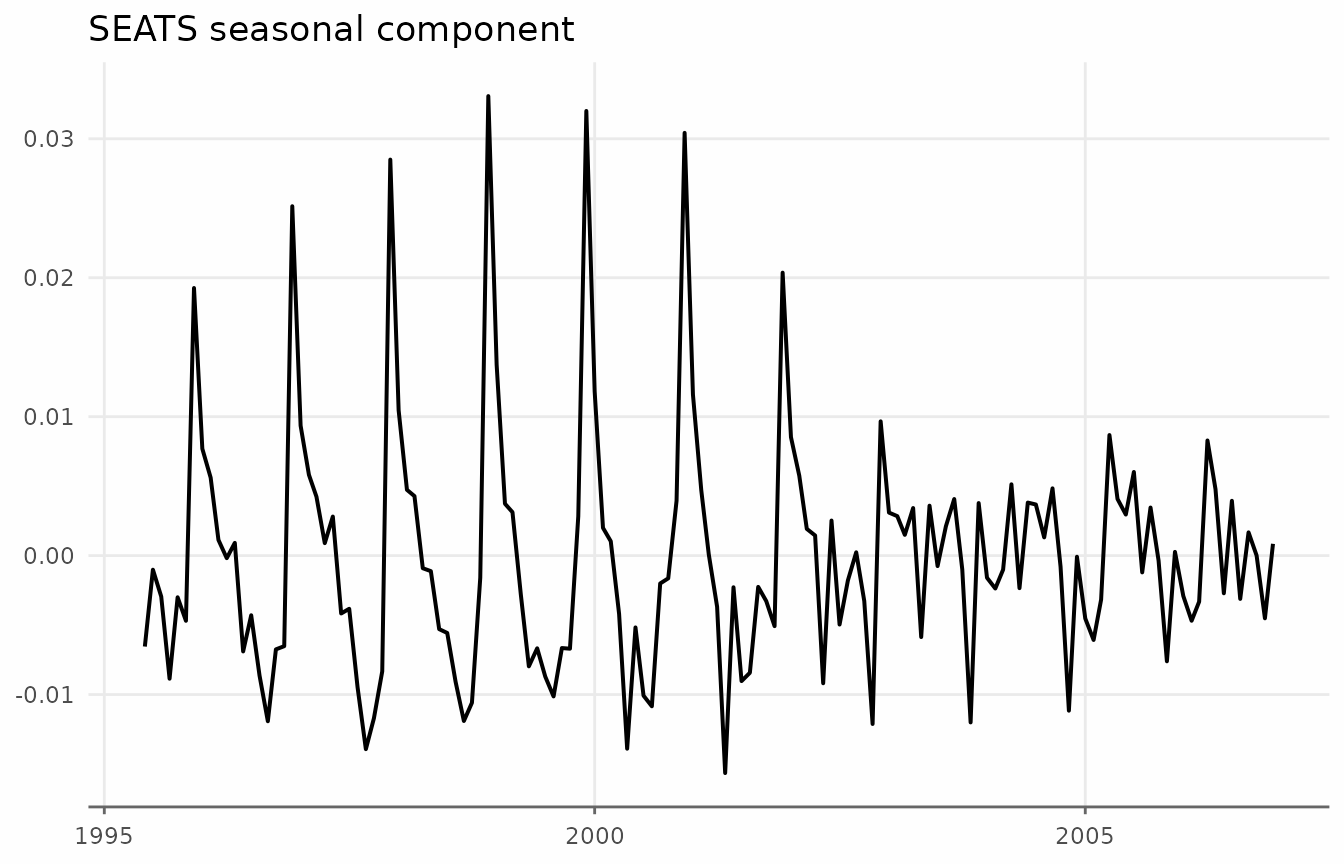
Often our interest is mainly in the series without its
seasonal component. For convenience, deseason_series()
wraps decompose_series() and returns the seasonally
adjusted series directly.
deseas_oil <- deseason_series(
  suboil,
  value_col = "lprod",
  methods = "seats",
  # set to TRUE to also return the trend, seasonal, and remainder components
  components = FALSE
)

ggplot(deseas_oil, aes(date, seasadj_seats)) +
  geom_line(lwd = 0.7) +
  labs(
    title = "SEATS seasonally adjusted series",
    y = "log production"
  ) +
  article_theme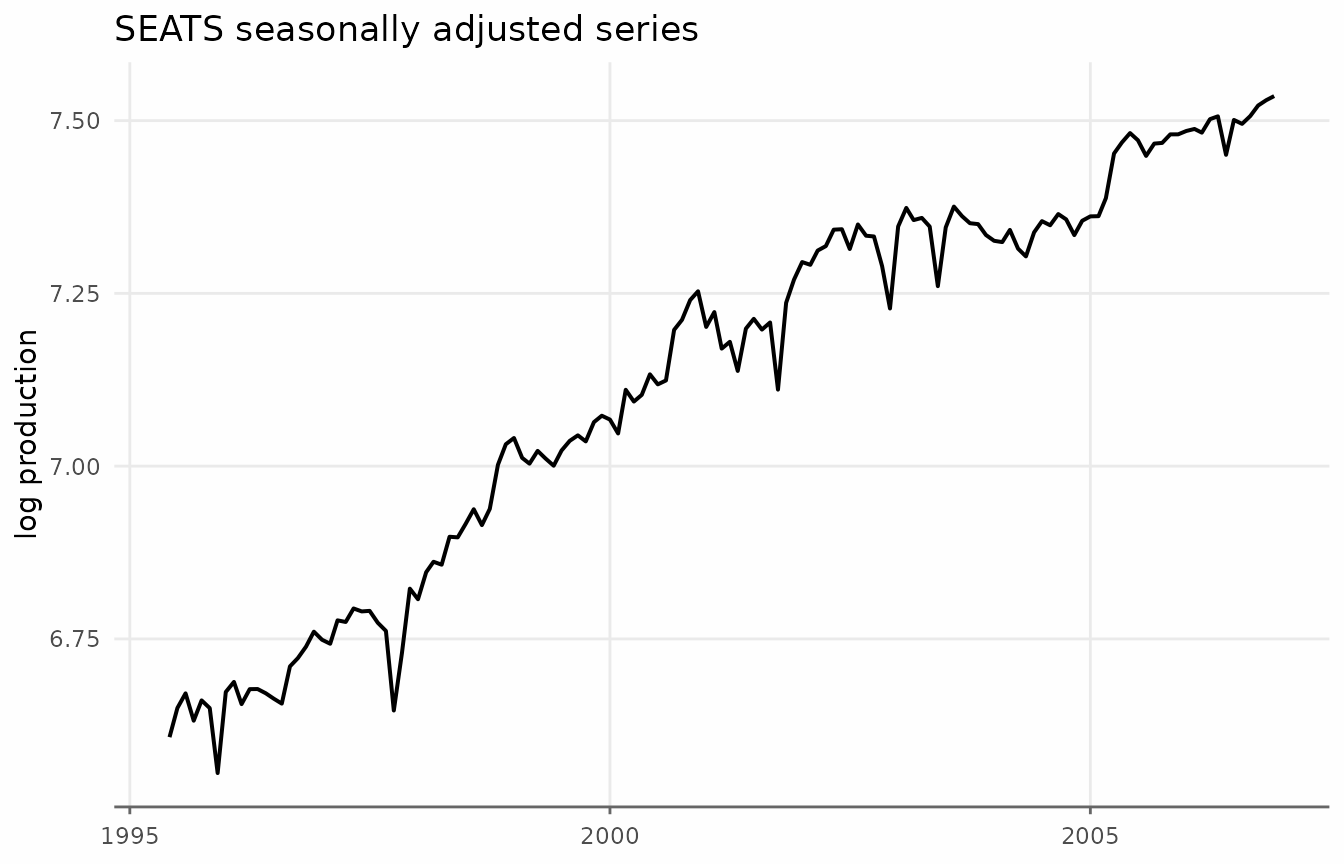
This is equivalent to using seasadj = TRUE in
decompose_series().
decompose_series(
  suboil,
  value_col = "lprod",
  methods = "seats",
  seasadj = TRUE
)
Summary
-
decompose_series()splits a seasonal (monthly or quarterly) series into trend, seasonal, and remainder components, which should sum back to the original series. - The methods available are
"stl"(default),"regression","classic","bsm", and"seats". - All methods are additive; use
transform = "log"for multiplicative seasonality, where the components instead multiply back to the series. -
deseason_series()is a convenience wrapper that returns only the seasonally adjusted series.